
In today’s digital world, artificial intelligence is becoming part of almost every industry. From voice assistants and recommendation systems to medical diagnosis and self-driving technology, AI is changing how people interact with machines. One of the most important technologies behind these developments is Neural Networks.
Neural networks are computing systems inspired by the way the human brain processes information. They allow computers to identify patterns, learn from data, make predictions, and perform tasks that traditionally required human intelligence. Although the concept has existed for decades, improvements in computing power, data availability, and machine learning techniques have made neural networks far more powerful and practical.
What Are Neural Networks?
A neural network is a type of machine learning model designed to recognize patterns in data. It consists of interconnected processing units commonly called artificial neurons. These neurons work together to analyze information and produce an output.
The basic idea is relatively simple. A neural network receives input, processes that input through several layers, and generates a result. During training, the network compares its predictions with the correct answers and adjusts its internal parameters to improve future predictions.
For example, imagine a system designed to recognize cats in photographs. The network can be trained using thousands or millions of images labeled as either containing a cat or not containing one. Over time, it learns useful visual patterns, such as shapes, textures, edges, and combinations of features. Eventually, it can analyze a new image and estimate whether a cat is present.
This ability to learn patterns from examples makes neural networks useful for a wide range of complex problems.
How Do Neural Networks Work?
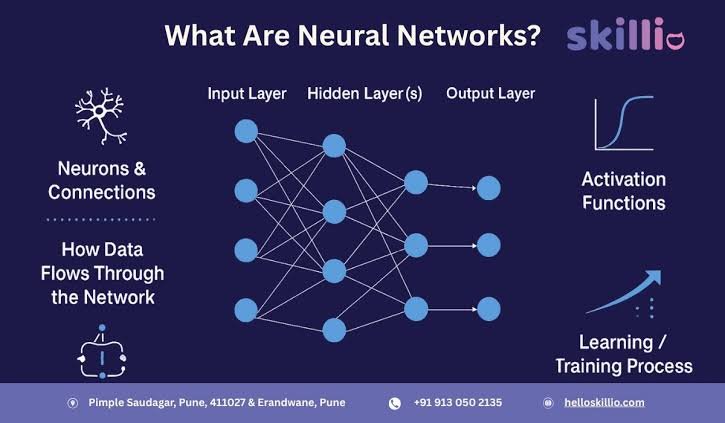
Most neural networks contain three basic types of layers: an input layer, one or more hidden layers, and an output layer.
The input layer receives information. Depending on the task, the input might consist of numbers, words, images, sounds, or other forms of data.
The hidden layers process the information. Each artificial neuron receives values from other neurons, applies mathematical calculations, and passes the result forward. Networks with many hidden layers are often described as deep neural networks.
Finally, the output layer produces the result. For example, it might identify an object in an image, predict a numerical value, classify an email as spam, or generate a probability for several possible outcomes.
During training, the network adjusts its weights. These weights determine how strongly different inputs influence a neuron. If the model makes an incorrect prediction, an optimization process adjusts the weights so that the network becomes more accurate over time.
One commonly used method for training neural networks is called backpropagation. It helps calculate how much each parameter contributed to an error and allows the model to make appropriate adjustments.
Types of Neural Networks
There are several types of neural networks, each designed for different kinds of tasks.
Feedforward Neural Networks
Feedforward neural networks are among the simplest forms. Information moves from the input layer toward the output without forming loops. They can be useful for classification and prediction tasks where the sequence of information is not especially important.
Convolutional Neural Networks
Convolutional Neural Networks, often called CNNs, are particularly effective for analyzing visual information. They can identify important features in images, making them widely useful in image recognition, facial recognition, medical imaging, and computer vision.
Recurrent Neural Networks
Recurrent Neural Networks, or RNNs, are designed to work with sequential information. They can use information from previous steps when processing later inputs. This makes them useful for certain language, speech, and time-series applications.
Modern systems often use more advanced architectures for sequence-related tasks, but RNNs remain an important part of the history and development of machine learning.
Transformer-Based Networks
Transformers have become extremely important in modern artificial intelligence. They are particularly powerful for processing language and other sequences because they can analyze relationships between different parts of the input efficiently.
Many modern AI applications, including advanced language models, rely on transformer-based architectures.
Where Are Neural Networks Used?
Neural networks have applications across almost every major technology sector.
In healthcare, they can help analyze medical images, identify potential diseases, support drug discovery, and assist healthcare professionals with complex data.
In finance, neural networks can be used for fraud detection, risk assessment, market analysis, and customer service automation.
In retail and e-commerce, they can power recommendation systems that suggest products based on a customer’s previous behavior. They can also help businesses understand customer preferences and improve search results.
In automotive technology, neural networks support computer vision, driver-assistance systems, object detection, and other features associated with autonomous driving.
They are also widely used in natural language processing. Applications such as translation, speech recognition, text classification, chatbots, and content analysis can rely on neural network technology.
Another familiar example is image and facial recognition. Smartphones, security systems, photo applications, and social platforms can use neural networks to identify objects, faces, and other visual patterns.
Benefits of Neural Networks
One of the biggest advantages of neural networks is their ability to learn from data. Instead of requiring programmers to manually define every possible rule, a neural network can discover useful patterns during training.
They are also highly flexible. The same general concept can be adapted for image analysis, language processing, forecasting, recommendation systems, and many other tasks.
Another benefit is their ability to handle large and complicated datasets. Traditional programming approaches can become difficult when the number of variables and possible patterns becomes extremely large. Neural networks can often identify relationships that would be difficult for humans to define manually.
With enough quality data and appropriate training, neural networks can also achieve impressive levels of accuracy. This has made them an important component of modern AI systems.
Challenges and Limitations
Despite their capabilities, neural networks are not perfect.
One major challenge is the amount of data and computing power they may require. Large models can take significant time and expensive hardware to train. Organizations without sufficient resources may find advanced neural network development difficult.
Another issue is interpretability. Some neural networks operate like complex mathematical systems in which it can be difficult to explain exactly why a particular decision was made. This is sometimes referred to as the “black box” problem.
Data quality is another critical factor. A neural network learns from the information it receives. If the training data is incomplete, inaccurate, biased, or poorly designed, the resulting model can also produce unreliable or unfair results.
There is also the risk of overfitting. A model may perform extremely well on the data it was trained on but struggle when presented with new information. Proper validation, regularization, and careful model design can help reduce this problem.
Neural Networks vs. Traditional Programming
Traditional programming generally involves explicitly writing rules that tell a computer how to perform a task. If a developer wants a program to calculate something, the instructions are manually created.
Neural networks take a different approach. Instead of defining every rule, developers provide training data and allow the model to learn patterns from that data.
Consider email spam detection. A traditional system might use manually created rules such as blocking messages containing specific words. A neural network can instead learn from large collections of spam and legitimate emails and identify patterns that are difficult to describe through simple rules.
This does not mean neural networks are always better. Traditional programming remains highly effective for many predictable and rule-based tasks. The best approach depends on the specific problem.
The Future of Neural Networks
The future of neural networks is closely connected to the broader development of artificial intelligence. As hardware becomes more powerful and algorithms become more efficient, neural networks are likely to become capable of handling increasingly complex tasks.
Researchers are also working on improving efficiency. Smaller models, better training methods, specialized hardware, and improved data techniques can make AI systems faster and less expensive to operate.
Another important area is responsible AI. As neural networks become more influential, researchers and organizations are paying greater attention to privacy, security, fairness, transparency, and reliability.
We may also see neural networks become more common in everyday software. Many users already interact with AI without realizing how much machine learning is operating behind the scenes. Search engines, recommendation systems, smartphones, translation tools, and digital assistants are just some examples.
Ultimately, neural networks are not simply a passing trend. They represent an important approach to building systems that can learn from information and adapt to complex patterns.
Frequently Asked Questions
1. What is a neural network in simple words?
A neural network is a computer system that learns patterns from data. It is inspired by the way biological brains process information. By analyzing examples, it can learn to make predictions, classify information, recognize images, understand language, and perform many other tasks.
2. Are neural networks the same as artificial intelligence?
No. Neural networks are a technology used within artificial intelligence and machine learning. Artificial intelligence is the broader field, while neural networks are one of the methods used to create intelligent computer systems.
3. What are neural networks used for?
Neural networks are used for many applications, including image recognition, speech recognition, language translation, recommendation systems, fraud detection, medical image analysis, forecasting, autonomous driving technology, and chatbots.
4. Why do neural networks need large amounts of data?
Neural networks learn patterns from examples. More high-quality and relevant training data can help a model learn a wider range of patterns and improve its performance. However, the amount of data required depends on the complexity of the task and the type of model being used.
5. Will neural networks replace human workers?
Neural networks can automate certain tasks, but they do not necessarily replace entire professions. In many situations, they are more likely to assist people by handling repetitive work, analyzing large amounts of information, or providing recommendations. Human judgment, creativity, communication, and responsibility remain important in many fields.
Conclusion
Neural networks have transformed the field of artificial intelligence by giving computers a powerful way to learn from data. Their ability to recognize patterns, make predictions, analyze images, understand language, and support decision-making has opened the door to countless applications.
At the same time, their limitations should not be ignored. Training costs, data quality, interpretability, bias, and reliability remain important challenges. Successful use of neural networks requires not only powerful technology but also responsible development and careful evaluation.
As artificial intelligence continues to evolve, neural networks will likely remain at the center of many technological innovations. Understanding how they work and where they can be used provides a useful foundation for understanding the future of AI.